I have two religions.
On the one hand, I am proudly Jewish, albeit a secular Jew. This is in spite of the fact that, as most of my friends and many of my acquaintances know, I am an atheist. Many non-Jews consider this to be a contradiction, but it's not - according to one survey, over a quarter of American Jews don't believe in God. (My own Judaism/atheism is complicated, beyond the scope of this post.)
My other religion is Science.
Why do I believe in Science? Simple. Because it works. Both the results and the process of Science have progressed over the millennia, and while it still isn't perfect, it is the best thing that humans have going for them.
So I guess you could say that my discovery of Jonah Lehrer's 2010 article The Truth Wears Off has given me pause. (Margaret actually saw it when it came out and has used it in her class, but happened to leave a copy of it laying around this week. I hadn't seen it before.) I've always known that Science's grasp on truth is always uncertain (that's part of the point of the scientific method), but I guess I didn't know that it is as tenuous as Lehrer makes out.
Am I having a full-fledged crisis of faith? Well ... no. But I do wonder if my lack of deep existential dread might be part of the problem - I don't want the scientific method to be fundamentally flawed, so I choose not to believe so. It just needs some tweaking and a bit more time to converge on highly-probable truths.
And yet, if I only believe this because I want to, how is that different from believing in God?
P.S. - one time I said to an acquaintance that Science is my religion, and he responded, "Scientology?" NO! Scientology is to Science as Astrology is to Astronomy. Please don't confuse them.
Sunday, January 27, 2013


Friday, January 25, 2013
Debugging Tips
A young pup of an engineer recently wrote to me:
There are other approaches. Some people take a top-down approach to debugging. Look at the code and what it is supposed to do, and try to figure out what is broken. It's all about, "Hmm ... that looks right ... so does that ... that should work ... gee, the code looks right to me. Guess I need to look harder." Yes, I'm making a bit of fun of it, but I have seen it successfully used. I know a guy who can often just look at a screen of code for a minute and point to the bug.
Top-down debugging almost never works for me. Bottom-up debugging asks the question: what is the code *actually* doing? It's all about about collecting evidence and saying, "Whoa, I wonder why it did THAT!" Followed by collecting more evidence. Unfortunately, most of that evidence is hidden deep inside the chips. So the job of the debugging engineer is to expose the evidence of what is going on.
Most people know how to use a source-level debugger to single-step code and examine variables, and this is fine for some bugs. At every step of the way, you can see exactly why it is doing what it is doing. But single-stepping runs out of steam in a hurry, especially when you need to see what's happening inside nested loops that might have thousands of iterations, or when the program is part of a system of multiple cooperating processes - you often can't use break points and single-stepping without breaking the larger system.
Instead of printing huge volumes of debug output, I like to define a function named kick_and_scream. The idea is that you add debug code to your program to test for unexpected conditions, and call kick_and_scream if something is wrong. You might pass in some interesting variables and structures which kick_and_scream will dutifully print the contents of, giving you some insight into the program's state. What it does next depends. Here are some things I've had kick_and_scream do after printing state variables:
I would write a new function: list_check. Pass it num_nodes and head_node and it does this:
So back to adding normal print statements and crawling through thousands of lines of output.
But what if, as I hinted above, the print statements are too disruptive? Like if they change the timing of the system too much?
I've had good luck with an event logger. Call it a poor-man's ultra-low-impact print statement. This is basically a global array treated like a circular queue. Instead of printing a like of debug output, you add debug values to the array. If the array fills, it cycles back to the beginning and overwrites the earliest values. So low impact that it won't have any effect on timing.
The use of the event logger still depends on detecting the problem inside the code and calling kick_and_scream. The kick_and_scream function would then print the contents of the array. It basically shows you the last N events which led up to the failure (where N is the size of the global array).
The disadvantage of this approach is that the output is MUCH harder to interpret than nice descriptive print statements. So I only use this when print statements disrupt the program too much to be useful. Which happens to be fairly frequently in the kinds of software I write.
I've implemented this several times, and I want to create a downloadable package for it. I'll announce it when it's ready.
UPDATE: http://blog.geeky-boy.com/2014/10/event-logger.html
- I was wondering (since I'm taking a coding class and I feel that one
of my weakest points is debugging), do you have any wisdom that you
could pass along? I would appreciate it immensely since it will most
likely save me a considerable amount of time on the MP's we have to
do. If my first coding class taught me anything, the longest part
about those assignments is the debugging process (and I was awful at
debugging my own code).
Bottoms Up!
Maybe I like debgging for the same reasion I like detective shows. It took me a long time to get tired of CSI, and I still like to watch the odd episode. I approach debugging like the CSI guys - I follow the evidence via a technique I call bottom-up debugging.There are other approaches. Some people take a top-down approach to debugging. Look at the code and what it is supposed to do, and try to figure out what is broken. It's all about, "Hmm ... that looks right ... so does that ... that should work ... gee, the code looks right to me. Guess I need to look harder." Yes, I'm making a bit of fun of it, but I have seen it successfully used. I know a guy who can often just look at a screen of code for a minute and point to the bug.
Top-down debugging almost never works for me. Bottom-up debugging asks the question: what is the code *actually* doing? It's all about about collecting evidence and saying, "Whoa, I wonder why it did THAT!" Followed by collecting more evidence. Unfortunately, most of that evidence is hidden deep inside the chips. So the job of the debugging engineer is to expose the evidence of what is going on.
Most people know how to use a source-level debugger to single-step code and examine variables, and this is fine for some bugs. At every step of the way, you can see exactly why it is doing what it is doing. But single-stepping runs out of steam in a hurry, especially when you need to see what's happening inside nested loops that might have thousands of iterations, or when the program is part of a system of multiple cooperating processes - you often can't use break points and single-stepping without breaking the larger system.
Kick and Scream
So what do you do if it's not feasible to single-step? Next in most people's bag of tricks is print statements. Sprinkle liberally throughout your program, printing the values of interesting variables and structures. The hope is that you'll catch the program as it starts to misbehave. But especially with looping programs where it can take a long time for the bug to manifest, the amount of output can be overwhelming. Plus, with cooperating processes, the slowdown introduced by prints can itself disrupt the behavior of the program, long before your elusive bug is caught. Or worse yet, the prints might change the timing of the program enough for the bug to disappear entirely. "Works just fine when I turn on debug output, maybe we should just ship it that way." :-) This is known as the observer effect where the act of measuring something changes the thing under measurement. (It is sometimes called the uncertainty principle, but this is not quite right. The uncertainty principle leads to the observer effect, but it is not the same thing.)Instead of printing huge volumes of debug output, I like to define a function named kick_and_scream. The idea is that you add debug code to your program to test for unexpected conditions, and call kick_and_scream if something is wrong. You might pass in some interesting variables and structures which kick_and_scream will dutifully print the contents of, giving you some insight into the program's state. What it does next depends. Here are some things I've had kick_and_scream do after printing state variables:
- Prompt and read a line from the user. This has the effect of essentially halting execution of the program, giving you a chance to fire up the debugger.
- Dump core - for Unix, you should be able to call "abort()". I assume Windows has something similar (Dr. Watson?). The idea is to get a memory dump of the program which can be examined with a debugger. In C, you can always force an illegal memory access:
*(char *0) = 0;
that often does the trick. - Infinite loop - I've done this for embedded systems whose operating systems are very basic and don't have any kind of core dumping capability. Maybe you have an in-circuit emulator or an external debugger that you can use to interrupt the program and examine state. Having the program stuck in an infinite loop will prevent it from destroying the evidence.
-
cur_node = head_node;
for (i = 0; i < num_nodes; i++) {
if (cur_node.id == query_id) return cur_node;
cur_node = cur_node.next_node;
}
return NULL; /* not found */
Working Back
So, let's say you do the above and you determine that when it loops num_nodes times, the last node it checks has a non-null next_node field. This shouldn't happen - the last node should have a null next_node. You've made some excellent progress - now you know the probable proximate cause of not finding the node - num_nodes is out of sync with the list itself. But the bug isn't actually here. You want to find out where the list got out of sync with num_nodes in the first place.I would write a new function: list_check. Pass it num_nodes and head_node and it does this:
-
cur_node = head_node;
for (i = 0; i < num_nodes; i++) {
if (cur_node.next_node == NULL) kick_and_scream(...);
cur_node = cur_node.next_node;
}
if (cur_node.next_node != NULL) kick_and_scream(...);
Event Logger
The philosophy of kick_and_scream is to not print out reams of debug output, but instead to only print interesting information once an obvious problem is discovered. Sometimes, however, you really do need to see sequences. You might have some kind of state machine which processes input events, and you suspect that the events are arriving in an invalid order. (Ever try to close a file before you open it?) There may not be enough information available just printing current state - you need to see that state evolve as events are being processes.So back to adding normal print statements and crawling through thousands of lines of output.
But what if, as I hinted above, the print statements are too disruptive? Like if they change the timing of the system too much?
I've had good luck with an event logger. Call it a poor-man's ultra-low-impact print statement. This is basically a global array treated like a circular queue. Instead of printing a like of debug output, you add debug values to the array. If the array fills, it cycles back to the beginning and overwrites the earliest values. So low impact that it won't have any effect on timing.
The use of the event logger still depends on detecting the problem inside the code and calling kick_and_scream. The kick_and_scream function would then print the contents of the array. It basically shows you the last N events which led up to the failure (where N is the size of the global array).
The disadvantage of this approach is that the output is MUCH harder to interpret than nice descriptive print statements. So I only use this when print statements disrupt the program too much to be useful. Which happens to be fairly frequently in the kinds of software I write.
I've implemented this several times, and I want to create a downloadable package for it. I'll announce it when it's ready.
UPDATE: http://blog.geeky-boy.com/2014/10/event-logger.html
Maria Bamford
My daughter turned Margaret and me onto Maria Bamford. She is a comedian who has suffered from some mental illness issues, and her sense of humor is definitely not for everybody. Weird, downer, deadpan, awkward, and very very funny for people with a sick sense of humor (like me, and apparently Margaret and my daughter).
If you're up for an experiment, start with her twenty episodes of The Maria Bamford Show. If, after the first one, you don't absolutely hate it, try at least two more.
Then there's Maria Bamford's One Hour Homemade Christmas Special.
I hear she made some commercials for Target, and I should look those up too. Obviously they won't be as off-the-wall as her independent creations, but I bet I'll like them anyway.
And I guess I should spend some time with the fan channel.
If you're up for an experiment, start with her twenty episodes of The Maria Bamford Show. If, after the first one, you don't absolutely hate it, try at least two more.
Then there's Maria Bamford's One Hour Homemade Christmas Special.
I hear she made some commercials for Target, and I should look those up too. Obviously they won't be as off-the-wall as her independent creations, but I bet I'll like them anyway.
And I guess I should spend some time with the fan channel.
Friday, January 18, 2013
Blog tags
Tags are used to group posts. If you want to see all of my postings related to, say, "death", just click on the "death" tag and you'll see the list.
I like tags. It is better than a hierarchical system of organization since a particular item may be associated with multiple points in the hierarchy. E.g. I might have a post tagged as "coding" and "rants", if I have a rant about some aspect of coding.
[Aside - email clients traditionally use a hierarchical folders. But gmail (at least the web interface) gives you true tagging. I like that, but ironically don't use it.]
One complication of tags as an organizational model is that the tags themselves must be organized, especially if the number of tags gets large. THAT strikes me as something which could be organize into a hierarchy. I might have a rants tag and a technical tag. The technical tag might be sub-divided into science and software. Software might be further subdivided into coding and debugging. My rant about coding would show up in both the "rants" tag and the "coding" tag.
Alas, this blogging system does not allow for organizing tags hierarchically ... at least not that I know of. It gives you two views:
The "tag cloud" is interesting. It uses different font sizes for the tags, depending on the relative number of postings given that tag. So rants might be big because I do a lot of ranting, while science might be small because I don't do much blogging about general science. The tag cloud gives an interesting view into my head even without clicking on any of them since they suggest which topics I feel passionate about (or at least chatty about).
That said, I'm thinking it is more of a novelty than a useful organizational model. (It's a novelty that I like, which is why I enabled it on this blog. But it will suffer from the same unwieldiness if I create a lot of tags.) For large numbers of tags, I'm still leaning towards hierarchical.
Since blogger doesn't support hierarchical, I guess I'll just muddle along for now. If my number of tags gets unwieldy, I can look at maybe leveraging the alphabetizing model to represent the hierarchy. For example:
rants
technical
technical-science
technical-software
technical-software-coding
I don't like that much, partly because the important part of the tag name becomes the last part, whereas the eye is drawn to the first part, obscuring the intent. Also, what if I want rants to be last? I guess I could do this instead:
01-technical
02---software
03-----coding
04---science
05-rants
That lets me order them any way I want to. But wow, what a pain if I want to insert a new tag, like say, software design. I'll have to renumber all the tags below it. I guess I could do the old BASIC trick of numbering them by 10s... (Who me? Program in BASIC? How old do you think I am, anyway?)
Another thought: assuming that each tag is simply a fixed URL, I could create a wiki page of the tag links and organize them any way I want to. I could then simply have a pointer to that page on the blog.
Ah well, enough thinking about this. Like I said, I'll just leave it a hodge-podge for now.
I like tags. It is better than a hierarchical system of organization since a particular item may be associated with multiple points in the hierarchy. E.g. I might have a post tagged as "coding" and "rants", if I have a rant about some aspect of coding.
[Aside - email clients traditionally use a hierarchical folders. But gmail (at least the web interface) gives you true tagging. I like that, but ironically don't use it.]
One complication of tags as an organizational model is that the tags themselves must be organized, especially if the number of tags gets large. THAT strikes me as something which could be organize into a hierarchy. I might have a rants tag and a technical tag. The technical tag might be sub-divided into science and software. Software might be further subdivided into coding and debugging. My rant about coding would show up in both the "rants" tag and the "coding" tag.
Alas, this blogging system does not allow for organizing tags hierarchically ... at least not that I know of. It gives you two views:
- Alphabetical
- Tag cloud
The "tag cloud" is interesting. It uses different font sizes for the tags, depending on the relative number of postings given that tag. So rants might be big because I do a lot of ranting, while science might be small because I don't do much blogging about general science. The tag cloud gives an interesting view into my head even without clicking on any of them since they suggest which topics I feel passionate about (or at least chatty about).
That said, I'm thinking it is more of a novelty than a useful organizational model. (It's a novelty that I like, which is why I enabled it on this blog. But it will suffer from the same unwieldiness if I create a lot of tags.) For large numbers of tags, I'm still leaning towards hierarchical.
Since blogger doesn't support hierarchical, I guess I'll just muddle along for now. If my number of tags gets unwieldy, I can look at maybe leveraging the alphabetizing model to represent the hierarchy. For example:
rants
technical
technical-science
technical-software
technical-software-coding
I don't like that much, partly because the important part of the tag name becomes the last part, whereas the eye is drawn to the first part, obscuring the intent. Also, what if I want rants to be last? I guess I could do this instead:
01-technical
02---software
03-----coding
04---science
05-rants
That lets me order them any way I want to. But wow, what a pain if I want to insert a new tag, like say, software design. I'll have to renumber all the tags below it. I guess I could do the old BASIC trick of numbering them by 10s... (Who me? Program in BASIC? How old do you think I am, anyway?)
Another thought: assuming that each tag is simply a fixed URL, I could create a wiki page of the tag links and organize them any way I want to. I could then simply have a pointer to that page on the blog.
Ah well, enough thinking about this. Like I said, I'll just leave it a hodge-podge for now.
Content Publishing
I created a page where I am basically talking to myself about the various ways that content can be published on the Internet, and which way(s) I might want to concentrate on. It is of minimal interest to anybody else.
http://www.geeky-boy.com/w/Sford_Content_Outlets.html
At present, I'm a minimal publisher, splitting content between my wiki and my blog. New Wiki content is sometimes announced in the blog - like this very post. (I also have a twitter and facebook accounts which I don't use due to low signal-to-noise ratios.)
http://www.geeky-boy.com/w/Sford_Content_Outlets.html
At present, I'm a minimal publisher, splitting content between my wiki and my blog. New Wiki content is sometimes announced in the blog - like this very post. (I also have a twitter and facebook accounts which I don't use due to low signal-to-noise ratios.)
Monday, December 31, 2012
Long emails
I have an article about writing effective long emails.
Those of you who know me are already rolling your eyes; I am well-known for writing long emails.
Why do I do it? I don't know if it's an egotistical pleasure in seeing my own verbosity, or if there is a genuine desire to leave the world a little better than how I found it. At this point in my life, I don't need to know why. I'm an email novelist, and that's that.
One thing I've learned is that a long email is a waste of time if it is not effective. I've spent many an hour fussing over a work of art, only to discover that nobody read it. Sound familiar? If so then you may benefit from my article: http://www.geeky-boy.com/w/Long_emails.html
Those of you who know me are already rolling your eyes; I am well-known for writing long emails.
Why do I do it? I don't know if it's an egotistical pleasure in seeing my own verbosity, or if there is a genuine desire to leave the world a little better than how I found it. At this point in my life, I don't need to know why. I'm an email novelist, and that's that.
One thing I've learned is that a long email is a waste of time if it is not effective. I've spent many an hour fussing over a work of art, only to discover that nobody read it. Sound familiar? If so then you may benefit from my article: http://www.geeky-boy.com/w/Long_emails.html
Sunday, December 2, 2012
Multicast Oddities
The operation of multicast is standardized, well-defined, and well-understood.
Or is it? (Insert ominous music here)
RFCs and other standards mostly apply to packets as they traverse the network. Network administrators take care of multicast infrastructure so that software developers usually don't have to worry about the subtleties of multicast connectivity and routing. However, what the operating system does inside a host is often not governed by formal standards. There are some corner cases related to multi-homed hosts where operating systems behave in non-intuitive or inconsistent ways that the software developer must be aware of.
In the scenarios shown below, we tested multicast connectivity with a set of simple multicast tools "msend" (for sending) and "mdump" (for receiving). See mtools for source and binaries for these programs. In all cases, the msends and mdumps use the same multicast groups and destination ports. The testing was done on four operating systems: Linux, Solaris-10, FreeBSD, and Windows.
SCENARIO 1: UN-ROUTED

In this scenario, two interfaces are used, one for sending multicast packets and the other for receiving them. In particular, this scenario assumes that the two networks attached to the interfaces are not routed, at least not for multicast.
The results of testing the scenario are what you would expect - the mdump does not receive the traffic. This is true for all four operating systems.
No surprise here, right? Well, hang on tight; things are about to get more interesting.
SCENARIO 2: ROUTED

In this scenario, the two networks are routed. I.e. multicast packets sent to network 1 are routed to network 2. One would expect that the mdump would now receive the packets, right?
It does for Solaris-10, FreeBSD, and Windows. However, when tested with Linux, the mdump stays silent. We ran "netstat -g" and the kernel thinks it is joined to the multicast group on Network 2, and a "tcpdump" (with promiscuous mode turned OFF) indicates that the packets are, in fact, being received by the kernel. But for some reason, the Linux kernel is discarding those packets.
I, for one, consider this to be a bug in Linux. It violates application portability. That is, if the mdump is run on a separate machine connected to network 2, the packets are received just fine. But run it on the same machine as the sender, and it stops working.
SCENARIO 3: ROUTED, EXTRA MDUMP

In this scenario, a second mdump is added, joining network 1. One would expect both mdumps to receive the multicast, and in fact they both do. So the only surprise here is that mdump2 appears to have "fixed" the Linux bug in scenario 2.
SCENARIO 4: UN-ROUTED, EXTRA MDUMP
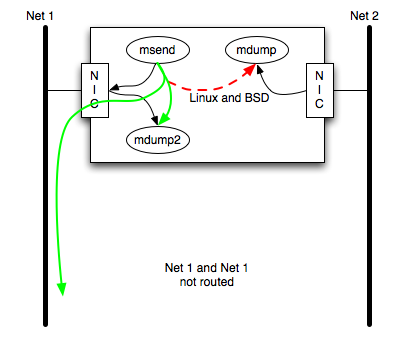
Things here get interesting again. Back to an unrouted scenario, with the second mdump. One would expect mdump2 to receive the data but not the original mdump.
This is what happens for Solaris-10 and WIndows. For Linux and FreeBSD, *both* mdumps receive the data. I consider this to be a bug for Linux and FreeBSD - why should an additional mdump change the behavior - but I consider it less serious than scenario 2's problem. In scenario 4, the problem is receiving more packets than expected, which could be filtered out by the application.
So, when dealing with multi-homed hosts, it is usually advisable to stick to a single interface if the networks are routed, or to use different multicast groups on each network if non-routed networks are used.
(BTW, this article was first published in 2009 on a different, now deleted, blog.)
Or is it? (Insert ominous music here)
RFCs and other standards mostly apply to packets as they traverse the network. Network administrators take care of multicast infrastructure so that software developers usually don't have to worry about the subtleties of multicast connectivity and routing. However, what the operating system does inside a host is often not governed by formal standards. There are some corner cases related to multi-homed hosts where operating systems behave in non-intuitive or inconsistent ways that the software developer must be aware of.
In the scenarios shown below, we tested multicast connectivity with a set of simple multicast tools "msend" (for sending) and "mdump" (for receiving). See mtools for source and binaries for these programs. In all cases, the msends and mdumps use the same multicast groups and destination ports. The testing was done on four operating systems: Linux, Solaris-10, FreeBSD, and Windows.
SCENARIO 1: UN-ROUTED
In this scenario, two interfaces are used, one for sending multicast packets and the other for receiving them. In particular, this scenario assumes that the two networks attached to the interfaces are not routed, at least not for multicast.
The results of testing the scenario are what you would expect - the mdump does not receive the traffic. This is true for all four operating systems.
No surprise here, right? Well, hang on tight; things are about to get more interesting.
SCENARIO 2: ROUTED
In this scenario, the two networks are routed. I.e. multicast packets sent to network 1 are routed to network 2. One would expect that the mdump would now receive the packets, right?
It does for Solaris-10, FreeBSD, and Windows. However, when tested with Linux, the mdump stays silent. We ran "netstat -g" and the kernel thinks it is joined to the multicast group on Network 2, and a "tcpdump" (with promiscuous mode turned OFF) indicates that the packets are, in fact, being received by the kernel. But for some reason, the Linux kernel is discarding those packets.
I, for one, consider this to be a bug in Linux. It violates application portability. That is, if the mdump is run on a separate machine connected to network 2, the packets are received just fine. But run it on the same machine as the sender, and it stops working.
SCENARIO 3: ROUTED, EXTRA MDUMP
In this scenario, a second mdump is added, joining network 1. One would expect both mdumps to receive the multicast, and in fact they both do. So the only surprise here is that mdump2 appears to have "fixed" the Linux bug in scenario 2.
SCENARIO 4: UN-ROUTED, EXTRA MDUMP
Things here get interesting again. Back to an unrouted scenario, with the second mdump. One would expect mdump2 to receive the data but not the original mdump.
This is what happens for Solaris-10 and WIndows. For Linux and FreeBSD, *both* mdumps receive the data. I consider this to be a bug for Linux and FreeBSD - why should an additional mdump change the behavior - but I consider it less serious than scenario 2's problem. In scenario 4, the problem is receiving more packets than expected, which could be filtered out by the application.
So, when dealing with multi-homed hosts, it is usually advisable to stick to a single interface if the networks are routed, or to use different multicast groups on each network if non-routed networks are used.
(BTW, this article was first published in 2009 on a different, now deleted, blog.)
LinkedIn Endorsements
LinkedIn Endorsements: you've probably received some. Maybe you've given some. I'm pretty much ignoring them.
I've been endorsed for software skills by people who have no software experience. Friends and relatives endorse each other even though they have no first-hand experience with that person's skills. It's like measuring a person's likability based on how many times they've been "liked" on FaceBook - it has more to do with the number of people you're connected to. Popularity is not a measure of skill mastery.
The cynical part of me thinks LinkedIn created them as a mental virus for the sole purpose of getting people to sign in more often, so they can get their ads to more eyeballs. (The cynical part of you might be saying, "Duh!") Similar to chain letters, the system asks you to endorse your connections, which sends emails, which prompts those people to sign on and issue endorsements.
All that said, I don't want to be antisocial. If you want me to endorse you for anything, let me know; I'll click as many skills as you like. And thank you for the good thoughts behind your endorsements of me.
Just don't use LinkedIn endorsements to evaluate my technical skills.
FYI - I consider LinkedIn recommendations to be different. Although they are susceptible to the same "you scratch my back, I'll scratch yours" reciprocity, I do consider them more useful then endorsements. For one thing, there's a bit more accountability - your name is on your recommendation. Also, they contain more information than a simple check mark.
UPDATE
Ok. I surrender. I went through my whole list of contacts and basically gave everybody a bunch of endorsements. I still think they are of near-zero value, and I won't ever use them to evaluate somebody else's experience.
I guess they're kind of like valentines - sure, we all know that Valentine's day is a manufactured holiday, and is commercialized, and it's more "real" to show your love through non-scripted acts, and blah blah blah. But you know what? SUCK. IT. UP. Give the damn Valentine card, along with a pot o' posies or a box o' chocs. Its not rational, but since when are humans bastions of rationality? It's just a form of social currency that you ignore at your own peril.
So yeah. I've gone through my whole list and given lots of endorsements. (And I got a flurry of them in return.) One more form of social currency to contend with.
I've been endorsed for software skills by people who have no software experience. Friends and relatives endorse each other even though they have no first-hand experience with that person's skills. It's like measuring a person's likability based on how many times they've been "liked" on FaceBook - it has more to do with the number of people you're connected to. Popularity is not a measure of skill mastery.
The cynical part of me thinks LinkedIn created them as a mental virus for the sole purpose of getting people to sign in more often, so they can get their ads to more eyeballs. (The cynical part of you might be saying, "Duh!") Similar to chain letters, the system asks you to endorse your connections, which sends emails, which prompts those people to sign on and issue endorsements.
All that said, I don't want to be antisocial. If you want me to endorse you for anything, let me know; I'll click as many skills as you like. And thank you for the good thoughts behind your endorsements of me.
Just don't use LinkedIn endorsements to evaluate my technical skills.
FYI - I consider LinkedIn recommendations to be different. Although they are susceptible to the same "you scratch my back, I'll scratch yours" reciprocity, I do consider them more useful then endorsements. For one thing, there's a bit more accountability - your name is on your recommendation. Also, they contain more information than a simple check mark.
UPDATE
Ok. I surrender. I went through my whole list of contacts and basically gave everybody a bunch of endorsements. I still think they are of near-zero value, and I won't ever use them to evaluate somebody else's experience.
I guess they're kind of like valentines - sure, we all know that Valentine's day is a manufactured holiday, and is commercialized, and it's more "real" to show your love through non-scripted acts, and blah blah blah. But you know what? SUCK. IT. UP. Give the damn Valentine card, along with a pot o' posies or a box o' chocs. Its not rational, but since when are humans bastions of rationality? It's just a form of social currency that you ignore at your own peril.
So yeah. I've gone through my whole list and given lots of endorsements. (And I got a flurry of them in return.) One more form of social currency to contend with.
Tuesday, August 21, 2007
What's this Blog for?
I don't know. At this point, it's for playing around and experimenting. I don't have the time or energy to post often enough to support a general audience, so I don't see myself becoming a "blogger" any time soon. But I may contribute technical content to a corporate blog and might want to post occasional non-corporate stuff related to my corporate postings. This is pure speculation, of course; chances are that this blog will die a quiet death of neglect.
Update (21-Jan-2013): I guess this is becoming what many blogs are - a hodge-podge of whatever I feel compelled to write about at the time.
That raises a question - from the time of its creation (Aug-2007) till very recently, the blog was door-nail dead. Did I not feel compelled to write during the past 12 years? The answer is yes, I have felt the impulse to write stuff all along. But I didn't have time to do anything so frivolous as blogging. I still don't have time to blog, but at this point in my life I figure I can get away with making more time to do frivolous things.
UPDATE (12-Jun-2014): Wow! 2014 is not yet even half done, and I've already produced more posts than the previous 7 years combined!
I see from stats that my page views is going up, but is still trivial compared to "popular" blogs. But that doesn't bother me much. In fact, the only thing that bothers me a little is the thought that I'm giving a lecture to an auditorium full of empty seats -- that's rather embarrassing. Fortunately, neither I nor anybody else has any way of proving that I'm talking to myself, and at my age embarrassment is the least of my worries. I enjoy posting, and as pointless hobbies go, this one is sure cheap. :-)
Update (21-Jan-2013): I guess this is becoming what many blogs are - a hodge-podge of whatever I feel compelled to write about at the time.
That raises a question - from the time of its creation (Aug-2007) till very recently, the blog was door-nail dead. Did I not feel compelled to write during the past 12 years? The answer is yes, I have felt the impulse to write stuff all along. But I didn't have time to do anything so frivolous as blogging. I still don't have time to blog, but at this point in my life I figure I can get away with making more time to do frivolous things.
UPDATE (12-Jun-2014): Wow! 2014 is not yet even half done, and I've already produced more posts than the previous 7 years combined!
I see from stats that my page views is going up, but is still trivial compared to "popular" blogs. But that doesn't bother me much. In fact, the only thing that bothers me a little is the thought that I'm giving a lecture to an auditorium full of empty seats -- that's rather embarrassing. Fortunately, neither I nor anybody else has any way of proving that I'm talking to myself, and at my age embarrassment is the least of my worries. I enjoy posting, and as pointless hobbies go, this one is sure cheap. :-)
Subscribe to:
Posts (Atom)